NEWS 23

🔒
❌
Stats
Es gibt neue verfügbare Artikel. Klicken Sie, um die Seite zu aktualisieren.

☐ ☆ ✇ Fox News

India and Israel elevate ties to 'special strategic partnership' status during Modi visit

veröffentlicht.
Vorschau ansehen

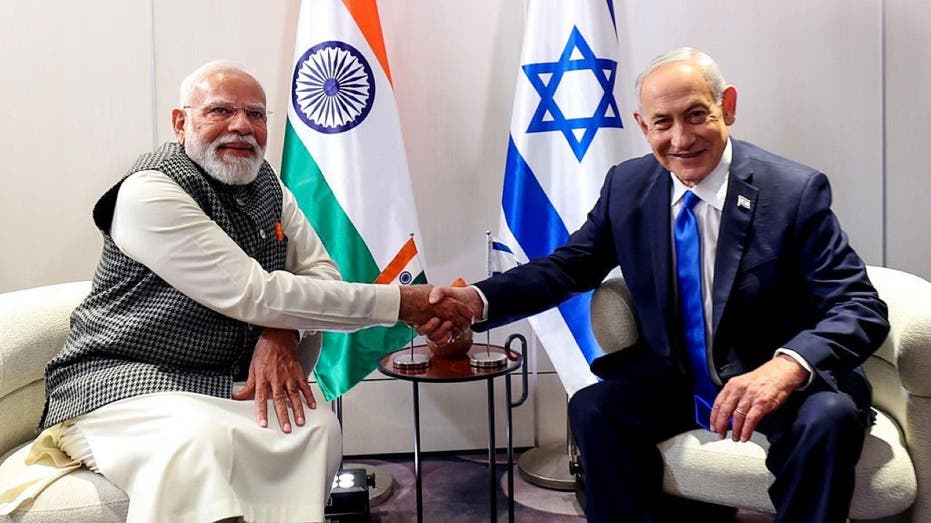
India and Israel declared themselves a "special strategic partnership" on Thursday after signing 16 new agreements, the two countries announced in a joint statement on Thursday.

Indian Prime Minister Narendra Modi met with Israeli Prime Minister Benjamin Netanyahu in Israel this week. Representatives of the two countries held working meetings this week to discuss agreements spanning security, agriculture, water, development and labor.

"This is an amazing visit. An amazing conclusion to an amazing visit," Netanyahu said alongside Modi. "It was short, but extraordinarily productive and also extraordinarily moving."

"The future belongs to those who innovate, and Israel and India are bent on innovation. We are proud ancient civilizations, very proud of our past, but also absolutely determined to seize our future and we can do it better together." he added.

TRUMP, NETANYAHU TO MEET AT WHITE HOUSE IN HIGH-STAKES TALKS ON IRAN, GAZA PLAN

The two countries ultimately signed 16 agreements spanning a range of topics, including artificial intelligence, cultural exchange, agriculture and energy, with Netanyahu adding that they are still working on a more "concrete" agreement.

"This friendship is built on a deep foundation of democratic and human values," Modi said, as translated by Israel's Ynet News. "Our ties have stood the test of time. Today we made a historic decision to elevate our longstanding partnership to a special strategic partnership, symbolizing the aspirations of our two peoples."

The elevated relationship comes as the U.S. and Israel have ramped up tensions with Iran. The U.S. has undergone a massive military buildup in the region, and Netanyahu discussed Iran with President Donald Trump during a White House visit earlier this month.

TRUMP ENVOY WITKOFF AND JARED KUSHNER IN GENEVA FOR CLOSELY WATCHED IRAN NEGOTIATIONS

Trump said Wednesday that he wants to resolve tensions with Iran through diplomacy, but he also accused Tehran of expanding its missile capabilities.

"They’ve already developed missiles that can threaten Europe and our bases overseas," he said. "And they’re working to build missiles that will soon reach the United States of America."

"My preference is to solve this problem through diplomacy," Trump added. "They want to make a deal. But we haven’t heard those secret words: we will never have a nuclear weapon."

"But one thing is certain, I will never allow the world’s number one sponsor of terror… to have a nuclear weapon. Can’t let that happen."

Fox News' Efrat Lachter contributed to this report.
(Auszug von RSS-Feed)

☐ ☆ ✇ Fox News

Taliban sends first envoy to India in diplomatic milestone as regional tensions reshape alliances

veröffentlicht.
Vorschau ansehen

Nearly five years after the Taliban’s takeover of Afghanistan, Kabul has appointed its first envoy to India, marking a significant milestone in diplomatic engagement between the two countries. 

Noor Ahmad Noor, a Taliban-appointed diplomat, has assumed responsibility as Chargé d’Affaires at the Afghan Embassy in New Delhi, the first such posting to India since the Taliban returned to power more than four years ago. The move is the latest step in cultivating goodwill, as India's role evolves in Afghanistan.

PAKISTAN THREATENS TO 'OBLITERATE' TALIBAN AFTER PEACE TALKS FALL APART

The renewed political and economic engagement with the Taliban comes at a time of surging cross-border violence between Afghanistan and Pakistan, which has plunged relations between the two neighbors to a dangerously low point. Just this week, tensions flared back up after a fresh round of deadly strikes and clashes. And nuclear-armed India wasted no time in strongly condemning Islamabad over the attacks and voiced support for Kabul’s sovereignty.

Against this backdrop of sustained hostilities, India stands out as one country that has much to gain. Experts say India’s reset with the Taliban reflects a pragmatic policy, aimed at countering Pakistani influence while protecting its own long-term security interests in the region.
 

"This is a classic case of ‘the enemy of my enemy is my friend,’" Sid Dubey, a visiting professor at Bennett University in India, told Fox News. "The only thing the two parties are mutually aligned on is Pakistan and the enmity both have toward the Islamic Republic."

Kabul’s rapidly deteriorating relationship with Islamabad factors heavily into India’s calculations. For decades, Pakistan sought what it called "strategic depth" in Afghanistan, backing Taliban factions to ensure a friendly government in Kabul. But now, as frictions rise over border disputes, closer coordination between India and Afghanistan stretches Pakistan’s capacity to manage tensions on multiple fronts. 

At the same time, analysts say, it gives India the opportunity to extend its influence in the region at the expense of another rival, China. Furthermore, Pakistan buffers India and Afghanistan, making strategic alignment between New Delhi and Kabul particularly significant.

TRUMP: US TRYING TO GET BAGRAM AIRBASE 'BACK' FROM TALIBAN IN AFGHANISTAN

"Afghanistan is cursed by its geography and proximity to foreign powers who will always meddle," Dubey explained, as regional fault lines only continue to sharpen. "And with virtually no American influence on the Taliban government anymore, Delhi feels secure in going ahead with its own India-centric Afghan policy."

Like most other countries, India does not formally recognize the Taliban regime in Afghanistan. Nevertheless, both nations have been taking a series of quiet but significant steps to deepen ties. Over the last year, several high-level diplomatic interactions have been billed as groundbreaking. Cooperation has expanded across the board, from healthcare and humanitarian aid to cultural exchanges and economic projects.

Dubey claimed there's another big reason for Delhi's push. "India supports all this in the hope or understanding that one day, if needed, India can use Afghanistan as a platform to strike Pakistan."

For its part, Kabul is embracing this new era of cooperation, hailing the stronger ties with India as Pakistan views these developments with deep suspicion. Engagement with India also offers the Taliban a measure of legitimacy on the world stage. 

As Dubey noted, Afghanistan remains one of the poorest and least developed countries in the world, heavily dependent on external assistance, making India’s aid extremely beneficial.

If sustained, India’s growing engagement with the Taliban could reshape changing regional dynamics. A weakened Pakistan-Taliban relationship undercuts Islamabad’s long-standing leverage in Kabul, altering the formerly established balance of power. It also complicates China’s calculus, as Beijing weighs its own security concerns.

Looking further ahead, if Washington again expands its involvement in Afghanistan, New Delhi could serve as a key intermediary, given that U.S. and Indian ties are also on an upward trajectory.

(Auszug von RSS-Feed)
❌