Anmelden


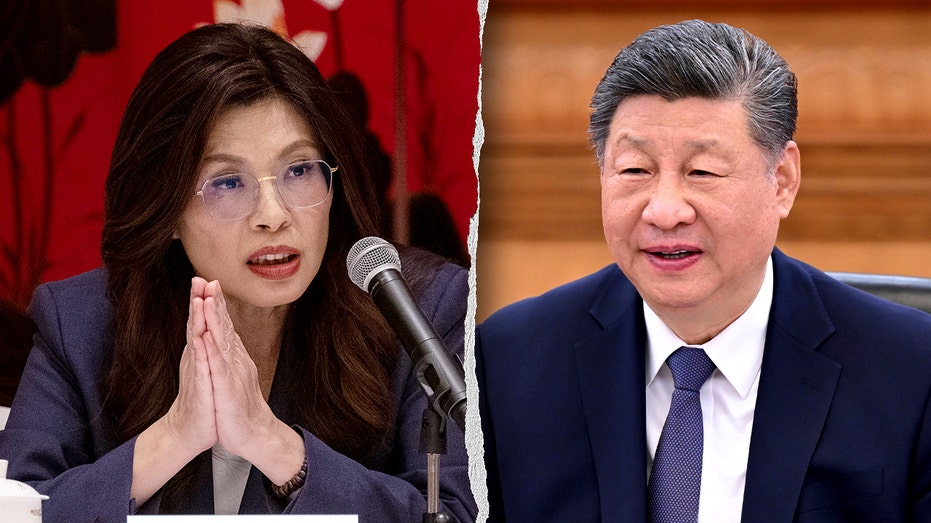
China said Sunday it would resume some ties it had suspended with Taiwan, such as direct flights and imports of Taiwanese aquaculture products, following a visit by the Beijing-friendly opposition leader of the self-ruled island.
The Taiwan Work Office under China’s Communist Party issued a statement saying it would explore setting up a longstanding communication mechanism between the Communist Party and Taiwan’s Kuomintang Party. It said it will facilitate the import of Taiwan’s aquaculture products that it had previously banned.
Cheng Li-wun, the head of the Kuomintang, and China’s President Xi Jinping held a high-profile meeting Friday during which they called for peace, without offering specifics. China claims the island as part of its territory and hasn't ruled out the use of force to annex it.
Taiwan's Mainland Affairs Council, which oversees the relationship with China, said the measures that were announced, such as promoting a communication mechanism, were "political transactions" between the two parties that circumvented the government of Taiwan.
TAIWAN OPPOSITION LEADER MEETS XI IN BEIJING AS TAIWAN DEFENSE FIGHT INTENSIFIES
"The government’s position is clear: to ensure the interests of the nation and its people, all Cross-Strait affairs involving public power must be negotiated by both governments on an equal and dignified basis to be effective and truly protect the rights and well-being of the people," the Mainland Affairs Council said in response to the Chinese announcement.
Relations between China and Taiwan, which remain split since 1949, have been tense since the election of pro-independence President Tsai Ing-wen from the Democratic Progressive Party in 2016. Beijing cut off most of its official dialogue with Taiwan's government, and has started sending warships and fighter jets closer toward the island on a daily basis.
BIPARTISAN HOUSE CHINA PANEL SLAMS BEIJING’S TAIWAN DRILLS AS ‘DELIBERATE ESCALATION’
In the statement, China said it plans to resume direct flights between Taiwan and mainland cities like Xi'an or Urumqi, although it remained unclear how the measures will be implemented without the approval of the Taiwanese government.
China banned its citizens from individual trips to Taiwan in 2019. Taiwan's rules now require Chinese visitors to hold a valid resident visa from another country, like the U.S. or the European Union, to apply for a visitor visa.
US INTEL SOFTENS ON CHINA THREAT, SAYS NO TAIWAN INVASION PLANNED BY 2027 DESPITE MILITARY BUILDUP
China also said it would work toward construction of a bridge that would connect the mainland to Matsu and Kinmen, Taiwanese islands that are closer geographically to China. The project is a longstanding proposal that Beijing has previously announced.
China banned the import of Taiwanese pineapples in 2021, and since then has extended it to other fruits and products including the grouper fish, squid and tuna.
After the initial ban on grouper, Taiwan’s Ministry of Agriculture said it approached China about making adjustments to ensure it met import requirements. China replied with a limited list of individual companies that were allowed to sell to China, but without explanation.
Iran could retaliate against a U.S. naval blockade of the Strait of Hormuz by directing its Houthi allies to disrupt another critical global shipping route, a senior Middle East analyst warned Sunday.
The Bab al-Mandeb — a narrow chokepoint linking the Red Sea to the Gulf of Aden — carries roughly 12% of global oil shipments and serves as a vital trade corridor between Asia and Europe, making it a strategic target for escalation that could further strain global energy markets.
"If the U.S. proceeds with its plan to blockade the strait, Iran’s escalation strategy could dictate that it ensures Gulf countries can’t export, either," Mona Yacoubian, director and senior adviser at the Middle East Program, told Fox News Digital.
TRUMP VOWS US WILL STRIKE IRAN’S POWER PLANTS, BRIDGES IF STRAIT OF HORMUZ IS NOT REOPENED
"This could translate to further attacks on Gulf energy infrastructure or even deploying the Houthis to blockade the Bab al-Mandeb," Yacoubian added.
Yacoubian’s remarks came after Ali Akbar Velayati, a senior adviser on international affairs to Iran's Supreme Leader, signaled Tehran’s view of the Bab al-Mandeb in light of potential U.S. action to block the Strait of Hormuz.
"Today, the unified command of the Resistance front views Bab al-Mandeb as it does Hormuz," he said in a post on X.
WHY THE STRAIT OF HORMUZ MATTERS AS TRUMP ISSUES FRESH ULTIMATUM TO IRAN
"If the White House dares to repeat its foolish mistakes, it will soon realize that the flow of global energy and trade can be disrupted with a single move."
U.S. Central Command released a statement Sunday saying the naval blockade would begin Monday and be "enforced against vessels of all nations entering or departing Iranian ports and coastal areas, including all Iranian ports on the Arabian Gulf and the Gulf of Oman."
President Donald Trump also said the U.S. Navy would block "any and all ships trying to enter or leave the Strait of Hormuz" in a post on Truth Social.
In March, the U.S. warned ships at the Red Sea chokepoint of Houthi attacks
"The Houthis continue to pose a threat to U.S. assets, including commercial vessels, in this region," a maritime advisory said of the Iran-backed armed group that controls much of northern Yemen.
TRUMP GIVES IRAN 48-HOUR ULTIMATUM TO REOPEN STRAIT OF HORMUZ OR FACE STRIKES ON POWER PLANTS
"Potential hostile actions include one-way unmanned aerial vehicle (UAV) attacks; unmanned surface vehicle (USV) attacks; unmanned underwater vehicle (UUV) attacks; ballistic and cruise missile attacks; small arms fire from small boats; explosive boat attacks; and illegal boardings, detentions, and/or seizures," it said.
"U.S.-flagged commercial vessels operating in these areas are strongly advised to turn off their AIS transponders," the advisory stated.
Yacoubian also determined in a Center for Strategic and International Studies (CSIS) report that Iran was threatening to expand the conflict further to the Red Sea and the Bab al-Mandeb compounding global market disruptions.
"It could leverage the Houthis, its Yemeni proxy, to once again wage attacks on the strategic waterway, depriving Saudi Arabia of its key workaround for oil shipments given the blockage of the Strait of Hormuz," she added.
The Houthis joined Iran’s war against the U.S. and Israel on March 28 when the organization launched two ballistic missiles at southern Israel. Both were intercepted.
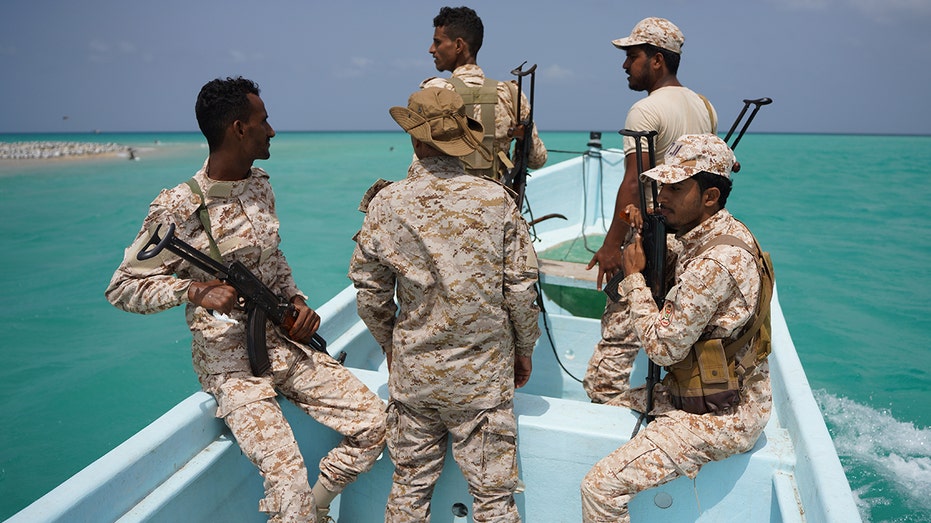
The United Nations’ shipping agency warned Thursday that imposing a toll on ships passing through the Strait of Hormuz would "set a dangerous precedent."
The remark comes after President Donald Trump suggested Wednesday that there may be a U.S.-Iranian toll system coming for ships that travel through the key waterway. Trump told ABC News, "We’re thinking of doing it as a joint venture," and, "It’s a way of securing it — also securing it from lots of other people."
"There is no international agreement where tolls can be introduced for transiting international straits. Any such toll will set a dangerous precedent," a spokesperson for the U.N.'s International Maritime Organization told Reuters on Thursday.
The Strait of Hormuz, which lies between Iran, Oman and the United Arab Emirates, is one of the world’s most critical energy choke points, carrying roughly 20 million barrels of oil a day along with about one-fifth of global liquefied natural gas.
LIVE UPDATES: US MILITARY 'LOADING UP AND RESTING,' TRUMP SAYS, AS IRAN TESTS CEASEFIRE
Greek Prime Minister Kyriakos Mitsotakis also warned on Wednesday that a reported Iranian plan to charge ships to pass through the Strait of Hormuz would be "completely unacceptable."
"I don’t think that the international community would be ready to accept Iran setting up a toll booth for every ship that crosses the strait," Mitsotakis, representing the world's leading shipping power, told CNN.
HEGSETH DECLARES 'DECISIVE MILITARY VICTORY' OVER IRAN
"This agreement cannot, I repeat, cannot include a sort of a fee that ships will have to pay every time they cross the strait," he continued. "This was not the case before the war started, and it cannot be the case after the war finishes."
The Trump administration had reached a ceasefire deal with Iran on Tuesday.
"The United States of America will be helping with the traffic buildup in the Strait of Hormuz. There will be lots of positive action! Big money will be made. Iran can start the reconstruction process," Trump wrote on Truth Social on Wednesday morning. "We’ll be loading up with supplies of all kinds, and just ‘hangin’ around’ in order to make sure that everything goes well. I feel confident that it will."
Fox News Digital’s Amanda Macias and Alexandra Koch contributed to this report.